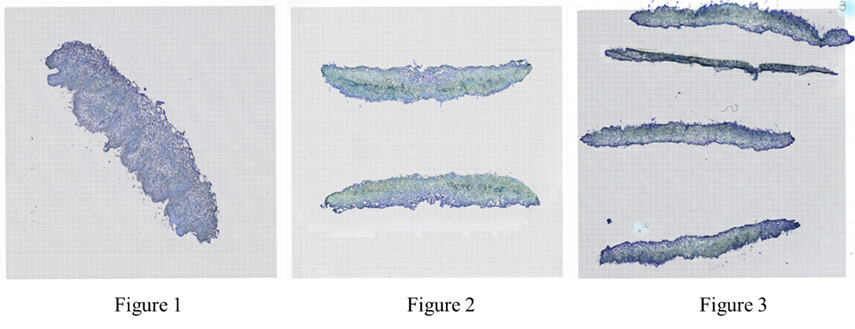
Rational arrangement of tissue within the limited area of spatial transcriptomics chips can better utilize the chip area, reduce experimental costs, and obtain more experimental data (see the figure below for the BMK platform’s 6.8mm × 6.8mm chip). We have designed differentiated chip layouts for tomato callus samples at different stages. For samples larger than 6.8mm but smaller than 9.6mm, a diagonal patching method can be used (Figure 1); for samples with a length smaller than 6.8mm and a width smaller than 3.4mm, two tissue sections can be patched within the chip area (Figure 2). Of course, for samples with a smaller width, we have also attempted to patch more material within the chip area. However, when the number of patches exceeds two, the operational difficulty significantly increases, which can easily lead to patching failure (tissue patch wrinkling or extending beyond the chip, Figure 3). Moreover, patching multiple tissue sections can prolong the patching time, reducing the quality of the sample RNA.