The quality of tissue sections is closely related to the spatial location information in spatial transcriptomics experiments. Therefore, we tested and optimized the embedding methods to ensure the integrity of the sections. During the testing of wheat anthers at the uninucleate stage, two embedding media, Sakura OCT and Neg-50, were used. The specific steps are as follows: (1) Load the embedding medium Neg-50 into a 2mL centrifuge tube and precool it on ice, with the cryoembedding machine prechilled to -80℃; (2) Place the anthers into the precooled embedding medium and vacuum on ice for 5 minutes to allow the embedding medium to penetrate the material; (3) After vacuuming, centrifuge at 3000 rpm and 4℃ for 2 minutes to remove excess bubbles around the plants; (4) Use a 17×17×5 mm embedding cassette for embedding and place it in the cryoembedding machine to solidify the embedding medium; (5) Store the embedded samples in a sealed bag at -80℃.
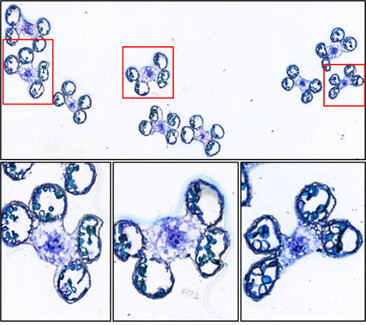
The sectioning results showed that using Sakura OCT for embedding easily led to separation between the material and the embedding medium, resulting in material detachment and folding (Figure 1). In contrast, the sectioning effect using Neg-50 is shown in Figure 2, with the overall morphology of the anthers being good. Therefore, Neg-50 was chosen for subsequent embedding.